intelligent-digital-twin-smart-parking
🏗️ Intelligent Digital Twin for Smart Parking Optimization



Final Year Project (PFE) | Engineer’s Degree Dissertation This repository presents an award-winning Intelligent Digital Twin designed to solve the energy inefficiency of urban parking guidance systems using Deep Reinforcement Learning.
🏆 Honors & Awards
This research was recognized for its innovation and impact:
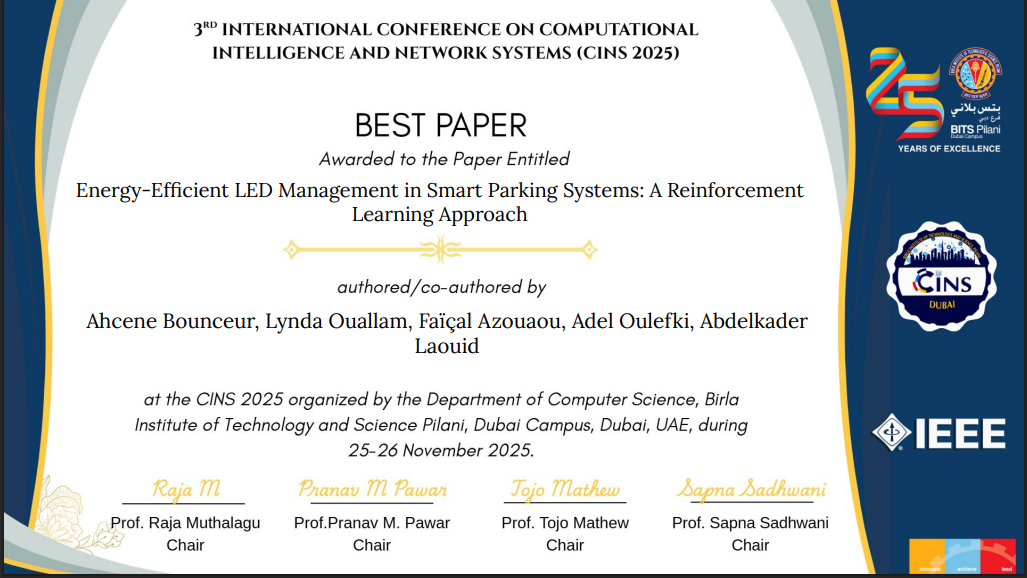
- 🌟 BEST PAPER AWARD at the 3rd International Conference on Computational Intelligence and Network Systems (CINS 2025), Dubai, UAE.
- 📄 Official Publication: Read the full paper on IEEE Xplore
📌 Project Overview
Modern smart parkings use LED-based guidance systems that consume massive amounts of energy. This project introduces a proactive Digital Twin orchestrated by a Reinforcement Learning (RL) agent.
🚀 Key Performance Results
- 81.8% Energy Reduction: Achieved by learning an optimal load-balancing policy that keeps infrastructure in “standby mode” for as long as possible.
- 60% Search Time Optimization: Improved user experience through intelligent vehicle distribution.
🎮 Live Interactive Simulation (Sandbox)
I developed a standalone web-based simulator to demonstrate the energy logic of the 4 different scenarios. No installation is required.
🧪 Scenarios Compared:
- Always-On: Traditional full-power mode.
- Green Only: Reactive mode (lights only for free spots).
- Smart Threshold: Agent activates lights only if floor occupancy > 50%.
- Advanced Balancing: Optimized floor selection based on real-time flow.
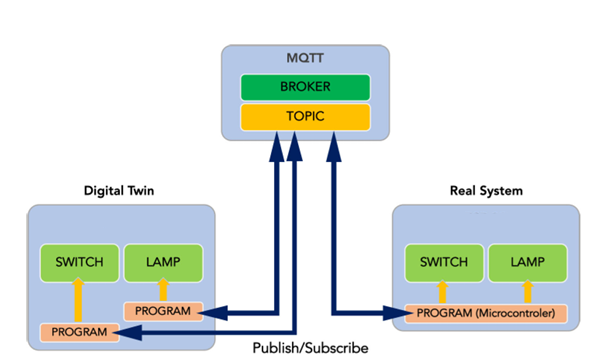
🌐 System Architecture
The project features a decoupled architecture ensuring real-time synchronization between the virtual model and the physical simulation.
🎨 Digital Twin Interface
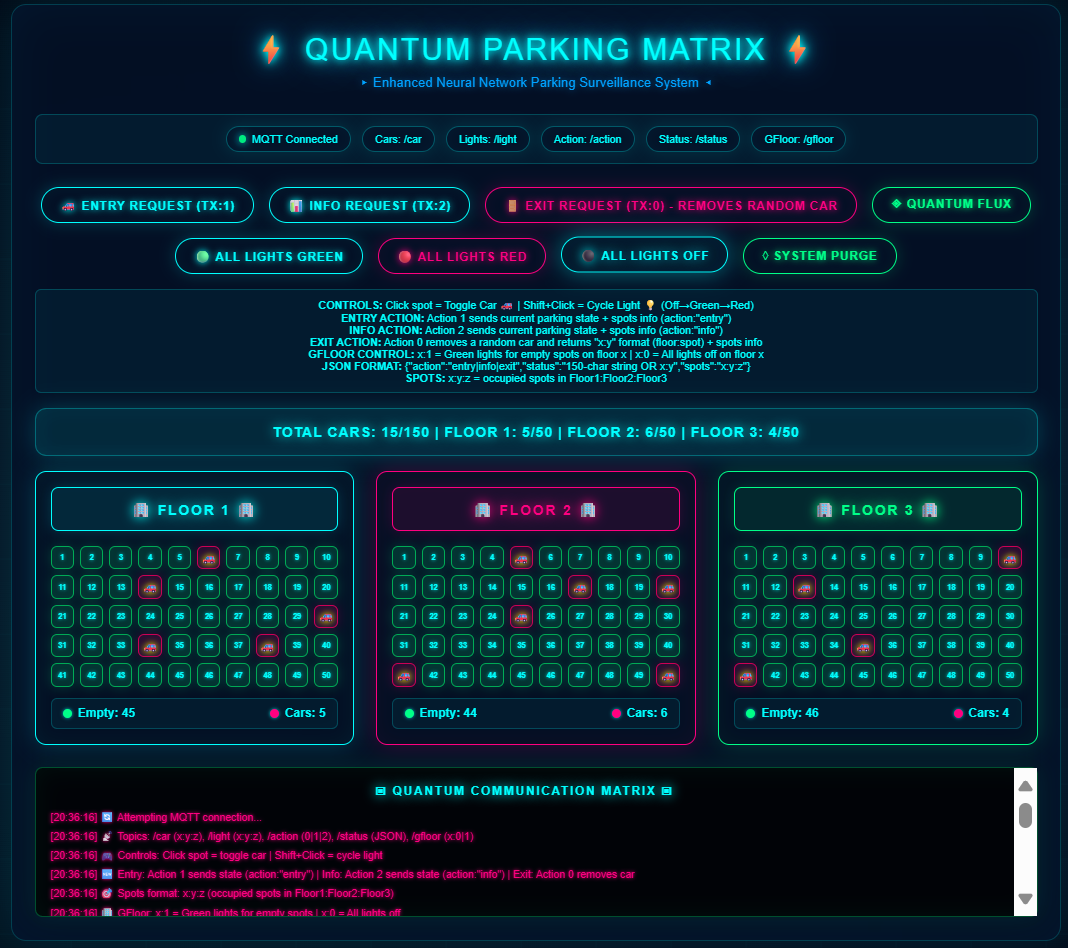
The “Quantum Parking Matrix” is a high-fidelity web dashboard (HTML/CSS/JS) that visualizes 150 parking spots and AI decisions in real-time via MQTT.
🧠 AI Core: Reinforcement Learning (DQN)
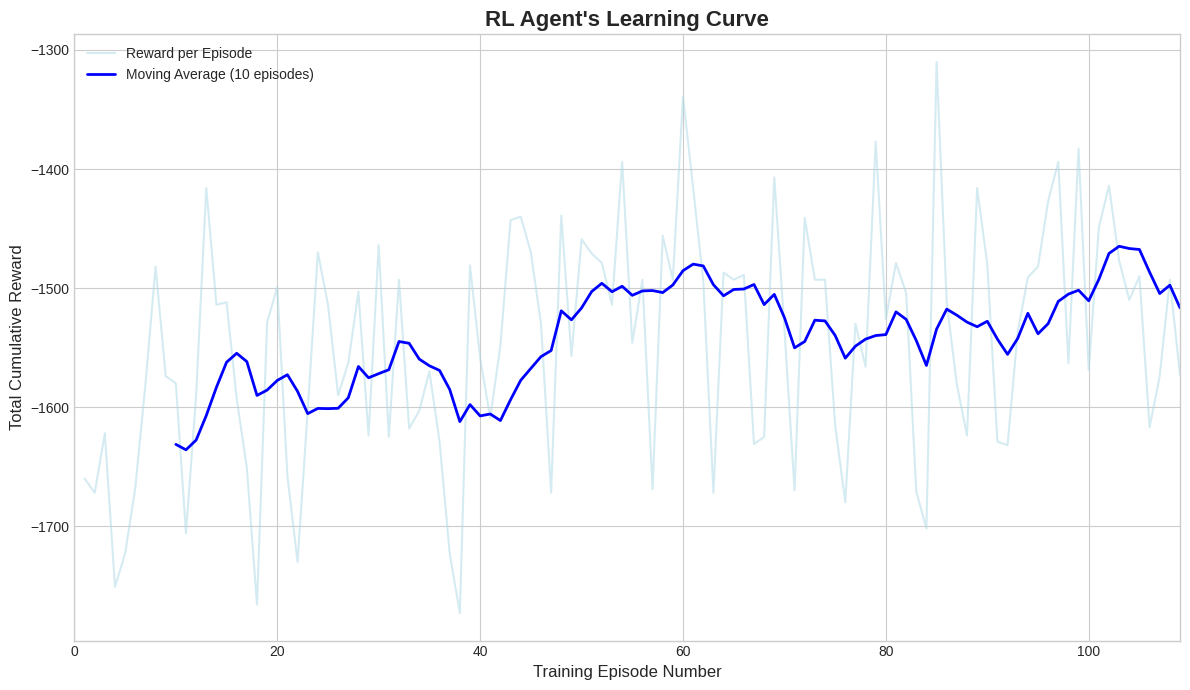
The agent (Deep Q-Network) learns to assign vehicles to specific floors to minimize energy-intensive states while maintaining service quality.
📊 Performance Metrics
| Learning Convergence | Training KPIs Evolution |
|:—:|:—:|
|  |
| 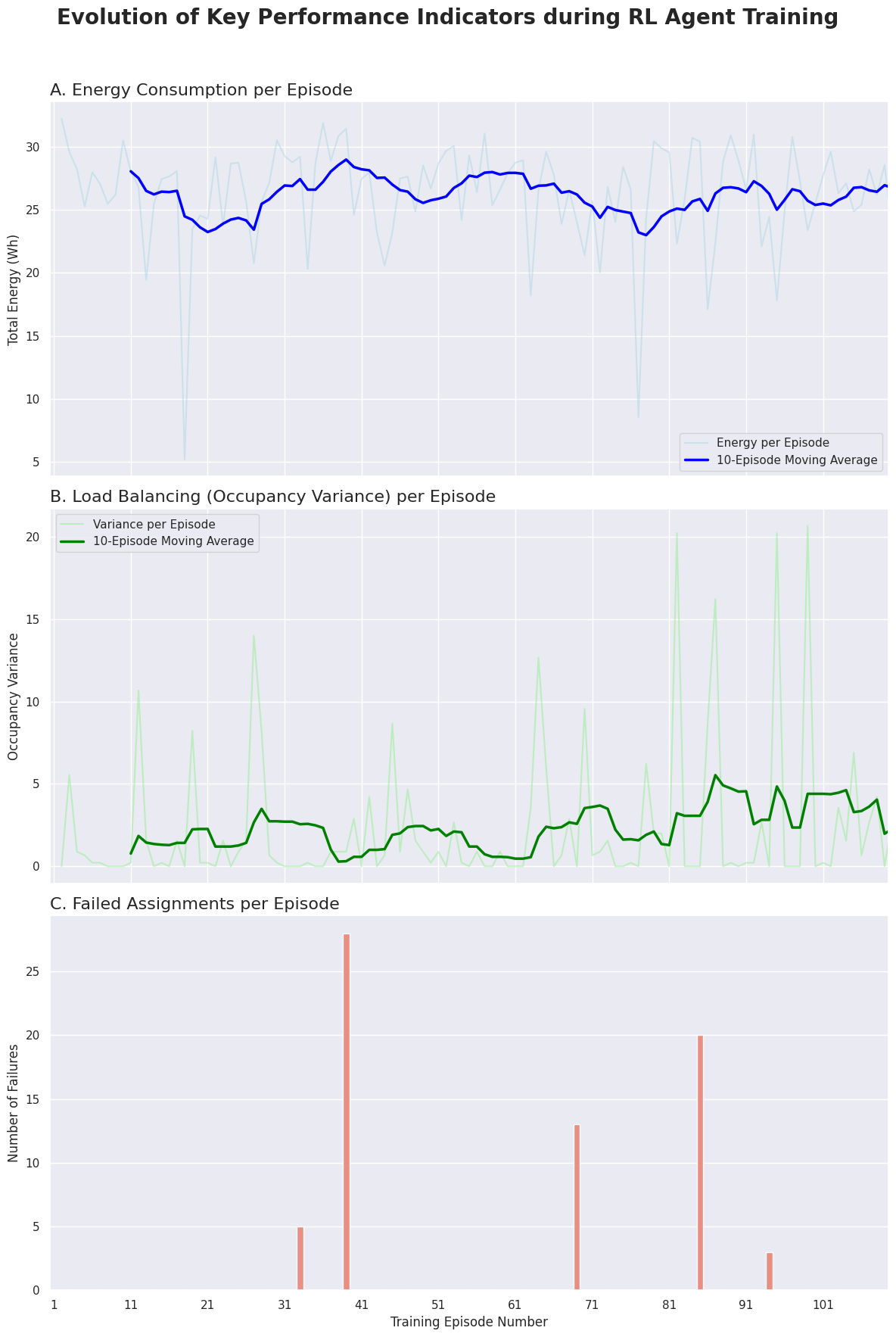 |
| Stable convergence achieved after 80 episodes | Drastic reduction in variance and failures |
|
| Stable convergence achieved after 80 episodes | Drastic reduction in variance and failures |
📊 Performance Analysis & Experimental Results
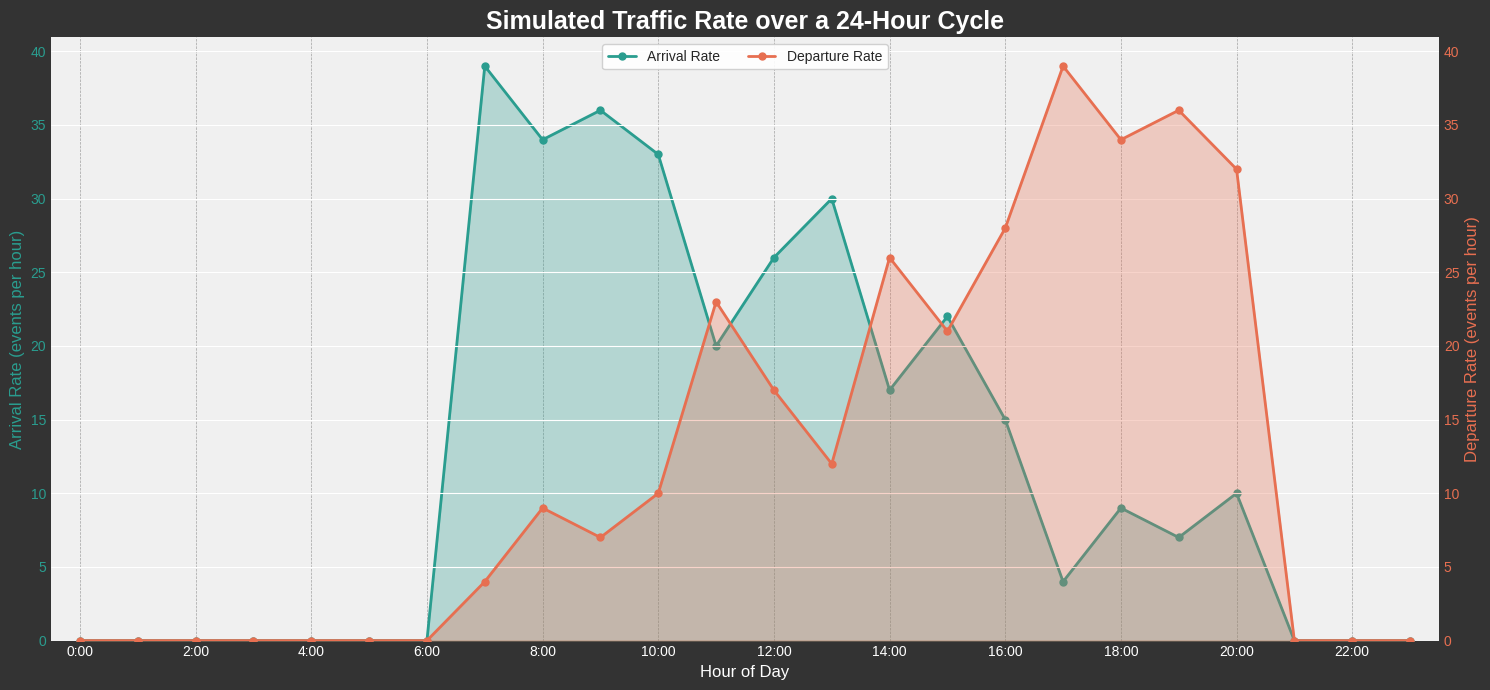
The effectiveness of the Intelligent Digital Twin was evaluated through a rigorous 24-hour simulation, comparing three distinct management strategies.
📥 1. Simulation Context
To mirror real-world conditions, we modeled a stochastic diurnal traffic cycle representing a typical urban business area, featuring morning and evening peak hours.
🧠 2. Learning Strategy (Epsilon-Greedy)
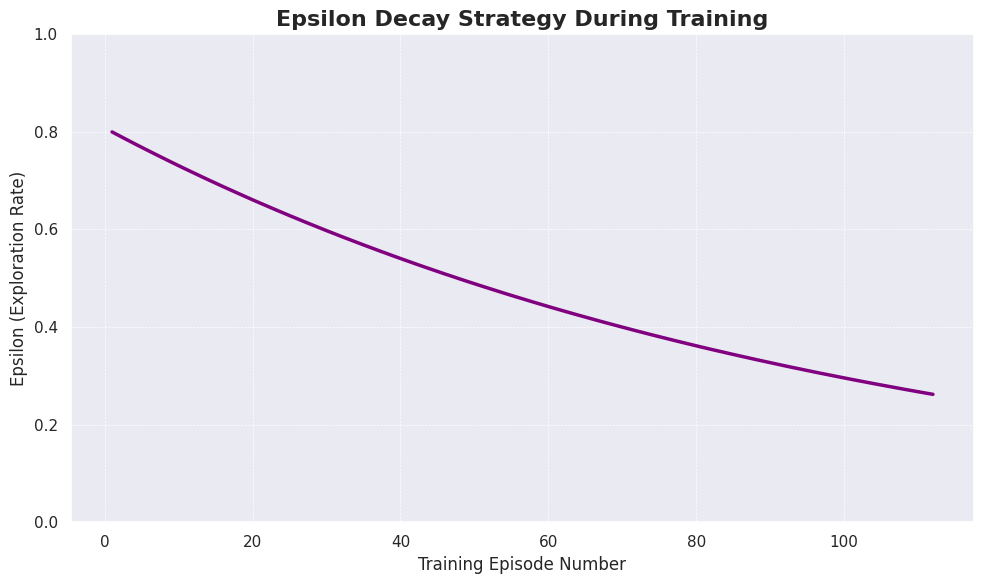
The agent uses an Epsilon-Decay strategy to manage the exploration-exploitation trade-off. It starts by exploring the parking environment and gradually transitions to exploiting its learned knowledge for optimal vehicle assignment.
⚡ 3. Energy Impact Comparison
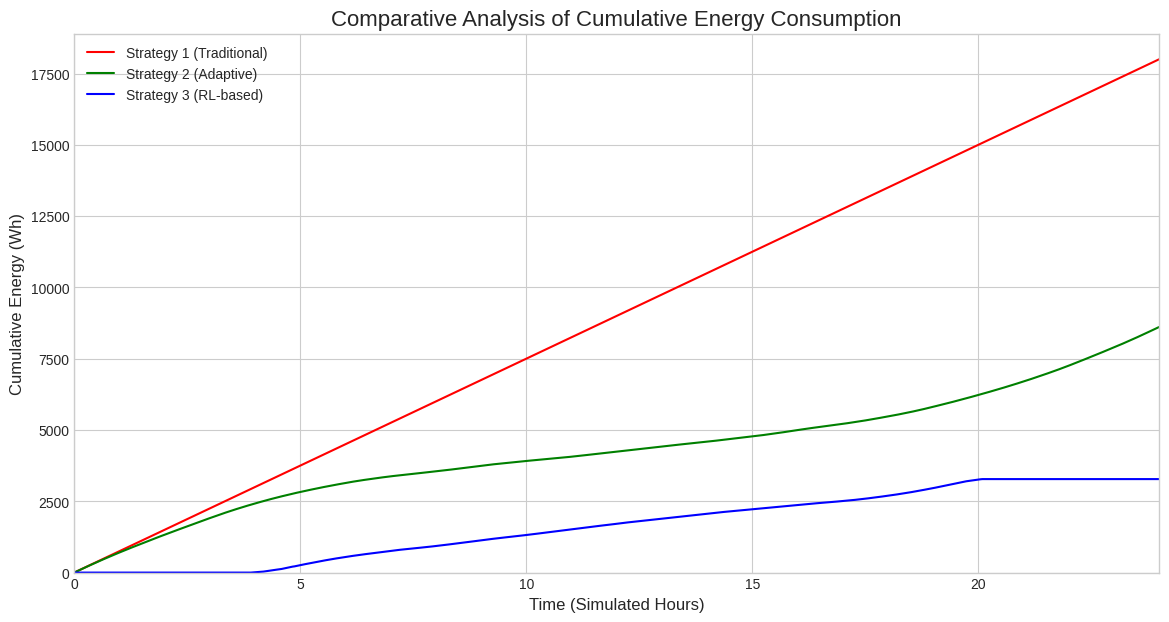
Our RL-based strategy (blue) was compared against the “Always-On” baseline (red) and the “All-Green” heuristic (green).
| Instantaneous Power Demand (W) | Cumulative Energy Consumption (Wh) |
|---|---|
 |
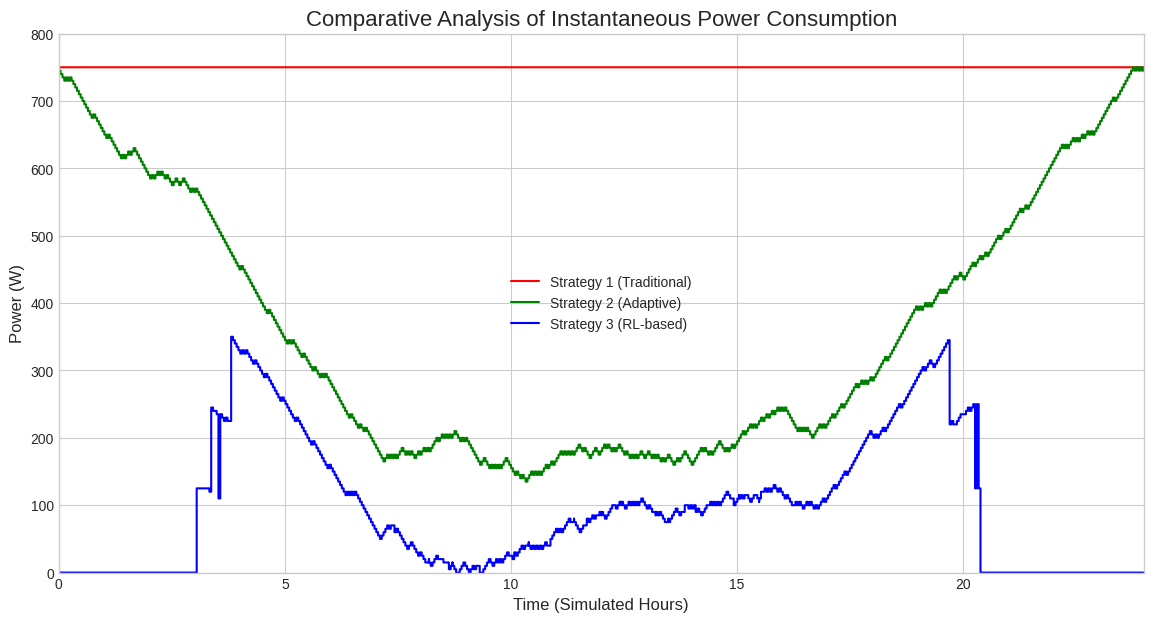 |
| Real-time adaptation to traffic | Final 81.8% efficiency gain |
Key Finding: While the heuristic approach reduces waste, only the Reinforcement Learning agent manages to keep the infrastructure in “standby mode” during low-traffic periods, leading to a massive 81.8% energy saving.
📁 Repository Structure
/docs: Full dissertation report and Best Paper Award documentation./rl-engine: Python scripts and Jupyter Notebooks for agent training and traffic simulation.- Includes
q_table_final.pkl: The pre-trained brain of the system.
- Includes
/ui-digital-twin: Source code of the interactive Web Dashboard./screenshots: Full gallery of research results and UI previews.
🛠 Tech Stack
- AI/ML: Python 3.9+, Scikit-Learn, NumPy, Pandas.
- IoT/Network: MQTT (EMQX), Paho-MQTT, MQTT.js.
- Frontend: HTML5, CSS3 (Modern Dark UI), JavaScript.
- Orchestration: n8n Workflows.
Developed by Lynda OUALLAM - Academic Year 2024/2025.
Supervised by Dr. Ahcene BOUNCEUR & Pr. Faïçal AZOUAOU.